
Recently, Friends of Warden Abbey Vineyard chairman, David Corfan, had the opportunity to chat with BBC Three Counties Radio host Andy Collins about the vineyard, wine and Beds RCC.
The conversion has been partly transcribed below. Full the full conversation, click play on the audio bar.
Andy
Did you know in Bedfordshire we have our very own vineyard, which dates back to medieval times. Now, Warden Abbey Community Vineyard is near Biggleswade in Bedfordshire and is run by a team of volunteers. David is the chairman of the vineyard and joins me; thank you for making the journey.
David
Very nice to be here.
Andy
Tell me a little bit about this vineyard.
David
It is a community vineyard; I’m from the Friends of Warden Abbey Vineyard, and we are a group of volunteers that actually do most of the work within the vineyard. So we tend the grapes all through the year.
The vineyard was originally planted, well, very originally planted hundreds and hundreds of years ago on the site of the little vineyard as part of Warden Abbey, which was a Cistercian monastery, in the area around Old Warden. Of course, Henry the Eighth, when he dissolved the monasteries the people of Bedford then took all the buildings away and built a prison and various other things in Bedford with the stones.
And then about 35 years ago, Lady Jane Whitbread, on whose land it is, decided she’d like to plant a vineyard. And she planted it on the site of the old vineyard. Then after a few years, it was taken over by the Bedfordshire Rural Communities Charity – Beds RCC – who I’m sure you’re well aware of, who run all sorts of community projects, wellbeing projects and Dial-a-ride bus projects – all sorts of things through Bedfordshire – and they decided they’d take the vineyard on as a community project.
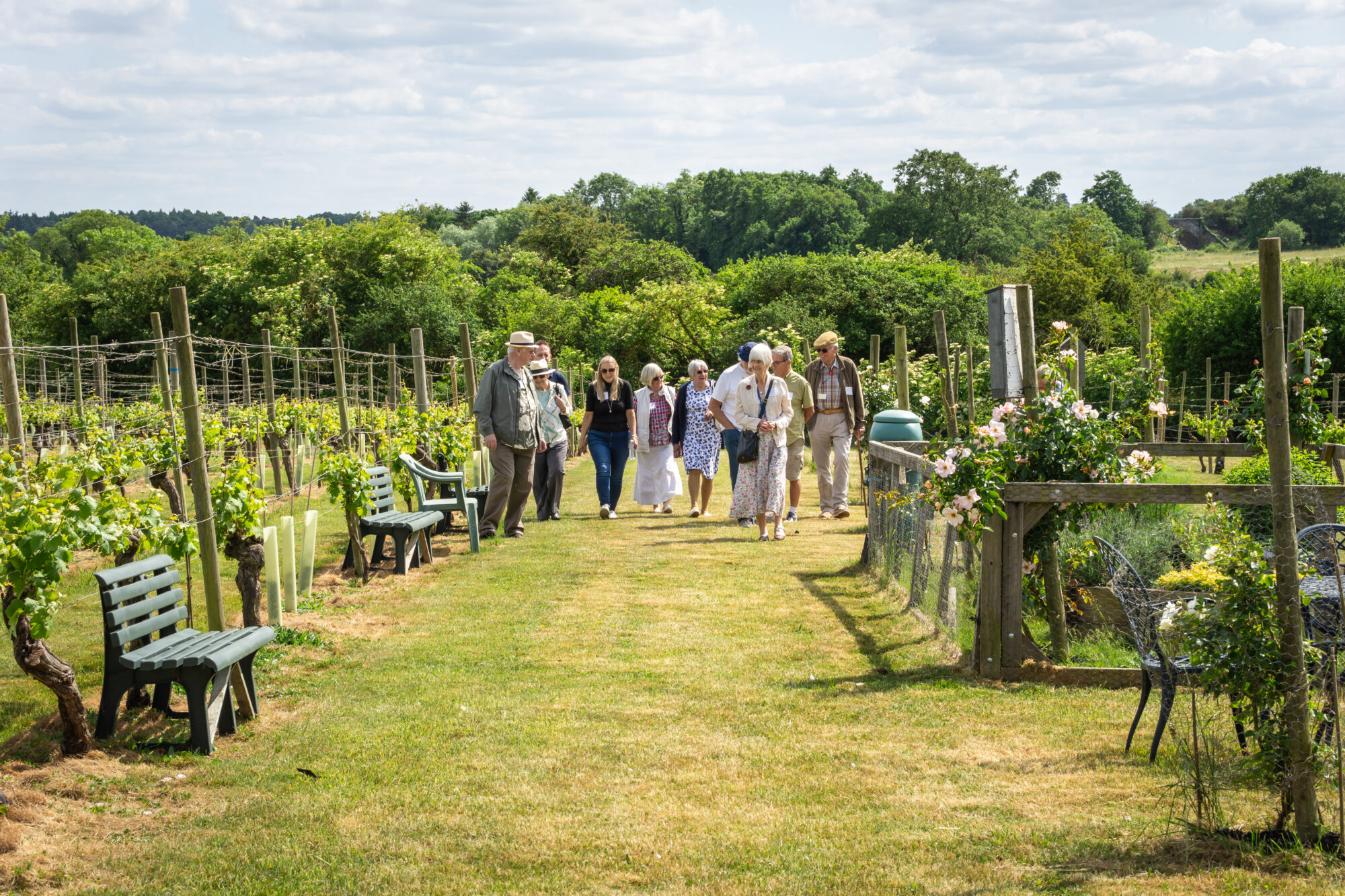
And we’ve been running it pretty much for the last ten years. The Friends have been helping to run it; Beds RCC has a vineyard manager who does all the sort of technical stuff, and then we do all the day-to-day work. It’s where you do wellbeing sessions for local people, there’s all sorts of community things that go on as part of Beds RCC, as well as fundraising activities that we do, like our upcoming Open Day in September. We run tours, we run other events in the vineyard.
Andy
If you said to anybody in the UK “vineyards”, they would instantly think of France, Italy, you know, because of the sunshine, the heat and stuff in the soil. Are there many vineyards in the UK?
David
There are loads of vineyards, hundreds of vineyards. Since the 80s, growing grapes has become a bigger and bigger part of UK agriculture. And, in fact, it turns out that wine grapes are actually the biggest soft fruit grown in this country now. So in terms of percentage, there’s like 27-28% of grapes, which is more than strawberries, more than raspberries, blackcurrants. It’s astonishing. Mainly in the south of England, but obviously with climate change, it’s gradually moving further and further north.
There’s at least three vineyards in Bedfordshire, that I know of. There’s also several in Hertfordshire and Buckinghamshire as well. So we’re all over the place.
Andy
And what type of wine are we producing?
David
It’s primarily white wine. Mainly because, in our case, our vines were planted 30-odd years ago and then the climate wasn’t quite as hot as it is now. And so the early vineyards tended to be planted with German-style grapes. We have Reichensteiner, Bacchus grapes, which are more climate-tolerant and came over from Germany. If you’re planting a vineyard today, you would be planting it with, potentially, red grapes, as well as wine grapes because the climate is getting warmer and warmer.
Andy
Champagne is grown in certain parts of France. Is that correct? It is. There’s a sparkling wine that’s made in England, which I think is better than the champagne that you get. I personally love it.
David
We have our own sparkling wine, which we make from our own grapes, which is unusual because it’s not the normal blend for champagne. Champagne is normally made from Pinot Noir, Pinot Meunier and Chardonnay grapes. And what’s now happening is a lot of the champagne houses from Épernay and from around France – the champagne region – are buying up land in East Sussex and Hampshire, and they’re moving into southern England because the landscape is the same. I mean, coming back to the farming thing, it’s all about the landscape. It’s all about the chalk downlands. And so the chalk land that you’ve got, where you’re growing grapes in northern France is very similar to what you’ve got in the South Downs, in Kent, in Sussex. And so they’re moving in. And that’s one of the reasons why wine grapes are such a big crop in this country, because the Moët & Chandons and the big champagne houses are moving up into southern England, as well as the English wine makers who are also making their own sparkling wine. But it tends to be called English Fizz because, as you say, it can’t be called “champagne” because of where the grapes are grown.
Andy
What are the biggest challenges of running a vineyard?
David
Just like any farmer, the weather, disease, manpower. One of the things that we’re very fortunate about is that we’ve got a lot of volunteers. And so actually getting stuff done manually is less of a problem for us than it is for a commercial vineyard because we might have 100 volunteers, maybe about 20 people come on a Tuesday. And it’s partly a social activity, partly helping to manage the vines, whereas a commercial vineyard may just have one guy running up, running around doing it. But I would say, still, it’s the weather. Last year was terribly, terribly, terribly wet. And the last couple of years have been wet and we’ve had a lot of mildew-type diseases in the vineyard because they just love the cooler, damp conditions.
This year has been better. The harvest is potentially going to be really, really good, but the threat of diseases is still upon you – just like it is for any farmer with any crops or whether you’ve got an orchard or arable farming; there’s always a threat of something going wrong at the last minute.
Andy
And what’s amazing is, like every other farmer that we’ve spoken to on the show this morning and across Beds, Herts and Bucks, you open your doors to the public, you encourage them to come in; and just looking through what you’ve got going on this year, you’re doing loads of tour dates where the people can come around the vineyard and have a look. You’re doing paella evenings, you’re doing picnic days, you’re doing afternoon teas. You’re doing a grand Open Day as well. There’s loads going on throughout the year. You love the public to get involved.
David
Yes, we do. And partly because we need to raise money to help keep the vineyard going because it’s just about sustainable, commercially, with the volunteer help. So we are raising money all the time. And our biggest fundraiser is our Open Day, which is on the 14th of September. There are people that live in Old Warden, in Shefford and Bedford that will come to the Open Day and they’ll go, wow, I had no idea this place existed. And you can be just down the road and you just would have no clue. And one of the reasons I’m delighted to be here is to give us a bit of publicity because even in the local area, people just don’t know we exist.